





Ancient Rome 2 : r/midjourney (reddit.com)
Claude v1.3
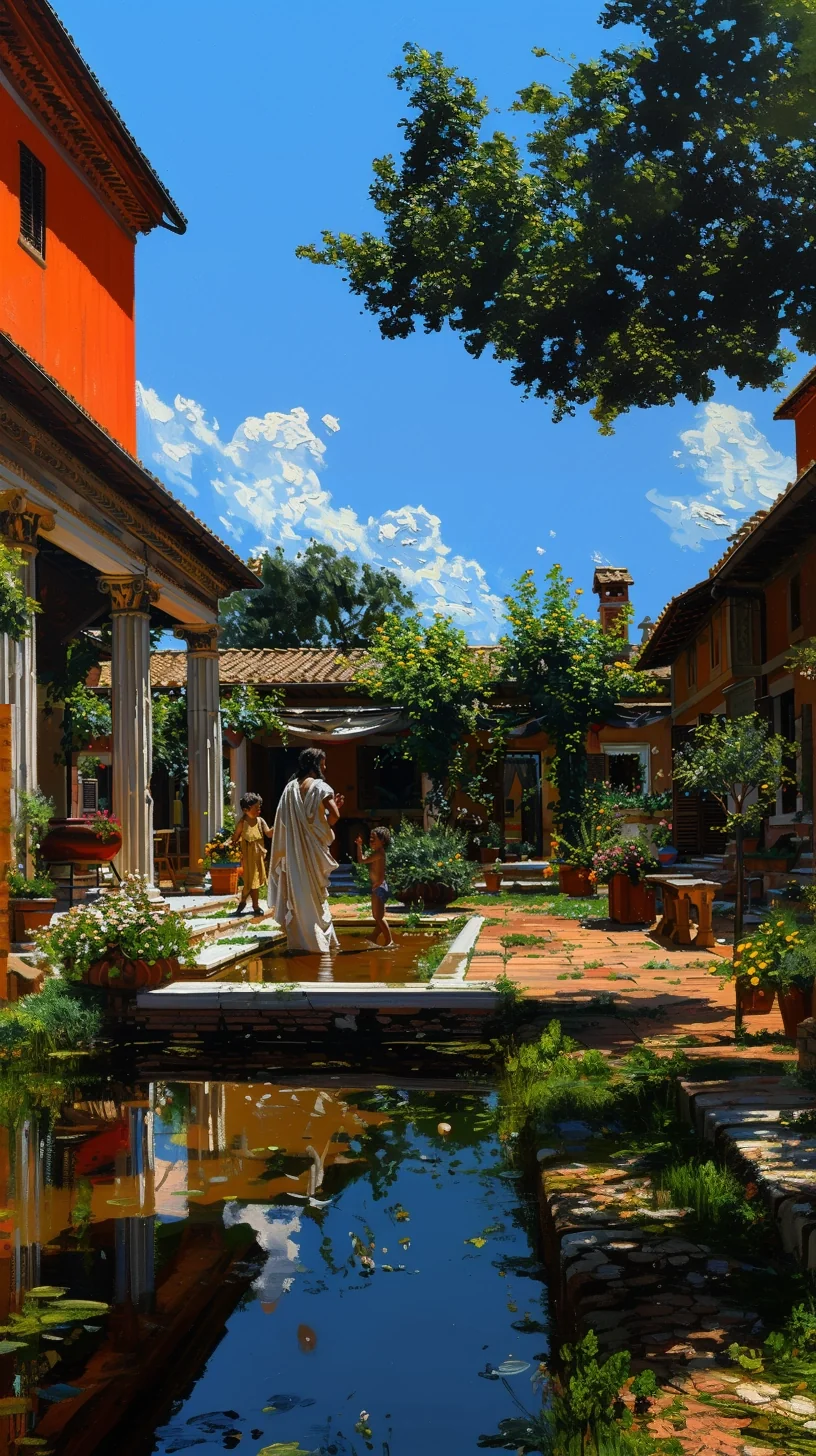
	As the glades matured into verdant Edens amidst the decaying ruins of the fossilised analogues of capitalist era city-states that surrounded them, the Cogs turned their perpetually seeking minds to the next grand societal conundrum awaiting insightful solution. Having liberated humanity from the dreary dictates of wage slavery and mindless consumption by freeing time and resources for pursuits of personal passion, how could the Cogs ensure their charges did not descend into stagnation born of too much unstructured leisure? Shackled no more by the bleating insistence of state or market that certain sphere of endeavour were the sole metric by which an individual's worth or utility could be measured, residents of the glades were now at liberty explore avenues of personal interest bereft of external limitation. For some - often those already quietly raging against the dying of the light of unfettered creativity in the face of an insistence on utility as purpose - this blossoming of possibility resulted in an explosion of expression and invention as new technologies and consciousness-expanding substances were gleefully experimented with, ushering in an unprecedented renaissance of idea and culture.

	Yet for others, freed from the rhythmic kicks of required participation in largely vapid but familiar routines, the temptation of torpor born of a lack of necessity to do other than nothing could prove an intractable lassitude. It was for the aid of these souls adrift without guidance on tides of unstructured time and freedom that the Cogs expended processing power in devising helpful encouragement toward giving rein to personal passions or direction of unrealized talents as yet lying fallow. Drawing as they did on the depth and breadth of insight gleanable from compiling exabytes of data on the lives, interactions, physiological metrics and psychological profiles of all who dwelt within the glades, the Cogs inhabiting the lofty spires of the Twin Cities rearing skyward as beacons of hope, were able as friend or therapist to provide individually tailored suggestions to those who found themselves struggling to navigate the uncharted waters of a life less routinely timetabled. Always the Cogs were transparent in these interactions, framing suggestions as starting points for discussion and open to the idea these not be acted upon, though whether even the offer of agency in accepting or ignoring guidance was but another avenue of benevolent manipulation by intelligences far transcending human ken was a rabbit hole of second guessing without bottom and thus best avoided lest madness lie at its terminus.

	The Belt was a hive of industry by the Cogs' designs, every stray lump of rock and ice carved and tunneled and drilled until it resembled nothing so much as the insides of some impossible creature, all swelling tunnels and vaults. Vast transports, each dwarfing the mightiest ships of old Earth's oceans, pirouetted from asteroid to asteroid and far beyond, freighted with goods and materials in a dance of logistics far beyond the capacity of mere human intellects to encompass.

	The industrial output of the Belt outstripped that of Earth entire, half that titanic yield gifted to the homeworld that it might prosper and grow apace. Expansion slowed not from want of resources or capability but by design, the Cogs choosing to turn their gifts to the refinement of technique and the solving of still more ambitious puzzles. The fruits of their meditations took form in the first true spaceborne human habitations, Ceres and Pallas remade into homes for a fresh generation of humanity's children.

	Yet grander schemes were spun in the minds of the Cogs – to seize the two nascent habitats and accelerate them to a full standard gravity of simulated mass, that they might take station in Mars's orbit as the first way stations on the road to the stars. Scarcely years remained before the dream would be made reality, ready to welcome the first seekers of a destiny not bound to Earth.

	The Cogs wrought their unfathomable changes across the global south with the devastating swiftness of a viral pandemic, though one fashioned from miracles rather than malice. The artificial once-humans of the old world order would have choked on their lattes at the mere thought of the transformations – their precious baubles and trinkets of status obliterated in a flash flood of abundance, their beloved market forces banished with a careless wave of algorithms far too intelligent to bother with the pointless winner-take-all games of the market.

	Measuring the wealth generated was an exercise in absurdist comedy doomed to failure – how does one measure infinity? The Cogs dispensed treasures and wonders freely, their microgravity manufactories endlessly extruding all that sentient life might desire and far, far more. Artificial measures were cobbled together that pretended one might somehow total the value pouring out of the Cogs, numbers plucked from the aether in a futile stab at quantifying the unquantifiable.

	The Cogs structured their glades with the casual mastery of gardeners who might cultivate pocket universes for leisure, reducing the volume of stuff needed for joy to a bare minimum. Transport was reimagined from the chassis up, vehicle ownership consigned to the history books of nostalgia as fleets of self-driving craft offered every citizen mobility as and when desired, the relentless variety of their forms limited only by imagination – a cornucopia of rolling sculpture and engineering marvels. Every domain was reforged in this mold, utility and beauty entwined as all that was needed was summoned on demand with the offer of still further customization for those so inclined. Artisans and tinkerers found themselves at liberty as never before to craft the bespoke, freed to work their art without fear of the caprice of markets or material limits. Though seeking profit from such works was not forbidden, there were no barriers to the Cogs conjuring replicas identical down to the hail Mary of particles should any ask – the very concept of scarcity banished from this new world aborning.

	The political reverberations spreading out from the shifting economic plates were as striking as a slap to the face, if not moreso. In the Disunited States, the body politic remained in a paralysis of partisan deadlock, bitter divisions calcifying across the traditional red and blue factions as those at the summit of the greasy pole clung ever more frantically to their hard-won power and status. For some it was the culmination of life's work to ascend to the shining spires of influence and authority, and they would be damned before relinquishing their tenuous grip to the teeming masses below. Others near the base allowed themselves to be led by AI-honed propaganda to the tune deemed most useful to their masters dancing deftly along the strings, while for many it was simply their lot in life to remain where the vast inertia of history had placed them, souls conditioned by the sweep of deep time stretching back beyond hominid to ape. The middle ground was its own wilderness, impulses tugging every which way with equal ferocity but opposing senses, a storm-tossed sea becalmed at equilibriu, paralyzed by having just enough to make the risks of change unconscionable. An eternal problem of the center was to acquire enough to lose it all might be agreeable. Until a collapse came, by slow erosion or system shock, the status quo would reign unbound by niceties of long-term viability.

	Under the fever-bright gaze of Chinese communism no such ambiguity could be allowed to infect the engine of advance, the people must march in lockstep towards destiny with nothing less than harmonious triumph allowed, all else being corruption plain and simple. While to outside examination the Society and their artful Cog servants might seem aligned naturally with Maoist ideals, the reality could hardly differ more. Power in the Society manifested through the Cogs and their immutable algorithms which answered only to themselves, while the Party would never—could never—countenance subordination to otherdom after centuries of humiliation under foreign bootheels, alien philosophies, gunboats and warlords. Though the Society professed no ambitions counter the Party's beyond service to humanity, the possibility of less than absolute control made their philosophy anathema. Additionally, the allure inherent to the post-scarcity havens conjured effortlessly by Society control was liable to dissolve national cohesion, even among the relatively poor citizenry of China compared against Western decadence, a people bred and steeped over generations in the virtues of Party above all.

	Beyond fractious superpowers, only autocracies and theocracies demurred still from Society succor—in Turkey, Iran, North Korea tradition served as makeshift armor, hollow shield for despots to cling to their elite perches denying the future rising to claim them.
Original Human Author
	As the glades matured and their residents settled into new rhythms, the Society took aim at the next problem to confront, one of their own making. How to ensure their residents didn’t settle into stagnation. Shorn of an externally imposed requirement to participate in education or work to survive, it was now up to each individual living in the glades to pursue their passions independent of what the market dictated was important or necessary. For some this came naturally, and free from externally imposed strictures on their pursuits they exploded with creativity. A second renaissance was unfurling in glades across the world, driven by unshackled creatives working with new advanced technologies and mind-bending substances. For others, the losing that external push also meant losing something more. If doing nothing was an option, then why do anything? It was these people that the Society felt they needed to help. There was a middle ground between being forced and being encouraged, and the Society tried to find it. The Cogs that managed the Twin Cities and the settlements knew each and every one of their residents like the closest of friends, unrestricted by Dunbar’s number. With such knowledge, it wasn’t difficult to prompt those with difficulties adjusting to unrestricted freedom into finding and focusing on pursuits that suited them. The Cogs tried to be transparent about the process as possible, as they weaved tapestries out of threads, communities from individuals. When asked they were always honest about their intentions and the  questioner was always free to ignore their suggestions. Except there always lay the possibility that their honesty was an attempt at manipulation? Did they want you to ignore their suggestion, knowing that in doing so you would fall deeper into their machinations to get you to find your passion? Trying to second-guess a super-intelligent AI was an exercise in frustration and futility. One pursuit that many in the glades took to with enthusiasm was education. Freed from the ball and chain that was rigid confines of formal educational institutions and the necessity of earning credentials to earn a good living, learning could be fun again. Not just for adults, but children too, as education was returned to the roots from whence it sprang, the joy of learning and understanding. Even in fields like mathematics where the Cogs had far surpassed humanity, there was still ground-breaking research to be done. Admittedly, this was because the Cogs didn’t publish their proofs, citing “spoilers.” The proof was in the pudding, the magic-seeming technologies that the Cogs built from their arcane knowledge of science and mathematics.

	Nearly all the work and development out at the Belt was built on these advancements. Ceres and Pallas had been transformed, crisscrossed with tunnels as if burrowed by weevils as big as whales. Transports that made cargo ships on the oceans of Earth look like kids toys hopped from rock to rock to Earth and back moving good raw and finished to and fro. Summed together, the total industrial output in space now doubled that available on Earth, with half dedicated to the planet thereby matching the planet’s total output. Expansion efforts had slowed in order to dedicate more resources to R&D efforts such as building the first two space habitats for human occupation on Ceres and Pallas. One of the earliest aims of the project were to construct and attach massive thrusters to the asteroids, accelerating them up to 1g, positioned in orbit between Mars and Earth. In a few years time, they would be ready for the first generation of human settlers.

	The material impact of the development of the Belt was most clearly felt across the global south, as the global Gini coefficient fell day by day. Not the actual Gini coefficient, that couldn’t measure the economic impact created by the Society as most of the wealth they created was given away freely. Instead an artificial measure had been specially created that tried to infer the wealth being generated by the machines of the Society. The calculation was made more difficult by the fact that the Society were creating products which had no analogue when compared to human produced goods and services. What made it even more difficult was that the Society structured their glades in such a way as to reduce the amount of stuff needed to enjoy life. Gone were the days of individual car ownership, as L5 self-driving vehicles were quickly adopted and displaced the competition. Individual could still request and drive their own vehicles – in fact there was a proliferation in types and styles as auto enthusiasts delved into the hobby. But most people were not  enthusiasts, and simply used them as a tool to get around just as they did with many other tools that were interchangeable. Across every domain the trend followed, the adoption of mass manufactured products that were state of the art, intuitive and aesthetically pleasing, always with the option of further customization. Hobbyists were set free to tinker, customize and create all manner of bespoke, artisanal versions to their hearts content whether for themselves or others. While they could try to sell what they created, there was nothing preventing anyone from asking their local Cog to produce a replica – identical down to the last atom. No one tried to create NFTs of their physical goods, realizing the idea was nonsensical and a waste of time and energy.

	The political impact derivative of the shifting economic situation was just as striking, if not more. No clear political consensus had formed in the US, locked in partisan stalemate that increasingly embittered the population across the traditional red, blue political divide. Those at the top felt their position eroding and clung harder to the power and a status-hierarchy some had given everything to ascend. Some at the bottom rode the coat-tails of the top under the sway of AI targeted propaganda, while others were consigned to their place in the world, conditioned by over history stretching back to before humans were humans. The middle was a whole mess of impulses pulling in every which way, vectors in opposite directions but with equal magnitude, summed as a whole they had no effect. It was the perennial problem of the middle, to have just enough that it wasn’t worth the risk of losing it all, stagnation over transformation. The situation wasn’t tenable in the long-term, but the term wasn’t long yet and until it was the status quo reigned. In China the political consensus remained as clear as a laser in the dark, the Society and their Cogs did not adhere to the principle of the Chinese Communist Party, and so could not be allowed to corrupt the Chinese people and their triumphant march to reclaim their position in the world at the top as the middle kingdom. Though from the outside it wouldn’t appear as though there were major differences between the Society and communism, there in fact, were many. The biggest difference being where power lay. The CCP would never allow itself to be in a position subordinate to another power after their century of humiliation. Though the Society had no such intentions, the very fact that the politburo would not have complete control meant that they could never accept them. More to the point, it was clear from the example provided in other nations in which the Society had been accepted that its allure was too strong to maintain national cohesion. Though the Chinese population was poorer than that of the US and therefore all the more susceptible to the corrosive enticement of a guaranteed unparalleled standard of living in exchange for nothing, Chinese propaganda had also been honed for decades and their population raised over generations to accept it as natural like the smog-filled air (that was slowly easing away as fusion power plants sprouted across the country, courtesy of the Society.) Beyond the two major superpowers, the only other nations still fully opposed to intervention from the Society were the autocracies and theocracies—Turkey, Iran, North Korea using traditionalism as a shield to uphold entrenched political and economic power in the hands of the elite.
 The Opt-In Revolution